KitchenAid mixer motor runs but the beater won't turn: what it means
By Alex at MixerFixer, Vaughan · Updated October 4, 2026
The short answer
Unplug it. When the motor runs or hums but the beater will not turn, the worm gear inside the head has almost certainly stripped. It is designed to do that: it gives way before the motor does. The mixer is not dead, it needs a new worm gear and a full re-grease, which is my full tune-up at $150 on a tilt-head and $175 on a bowl-lift. Do not keep switching it on to check. Every attempt grinds the broken teeth into the rest of the gearbox.
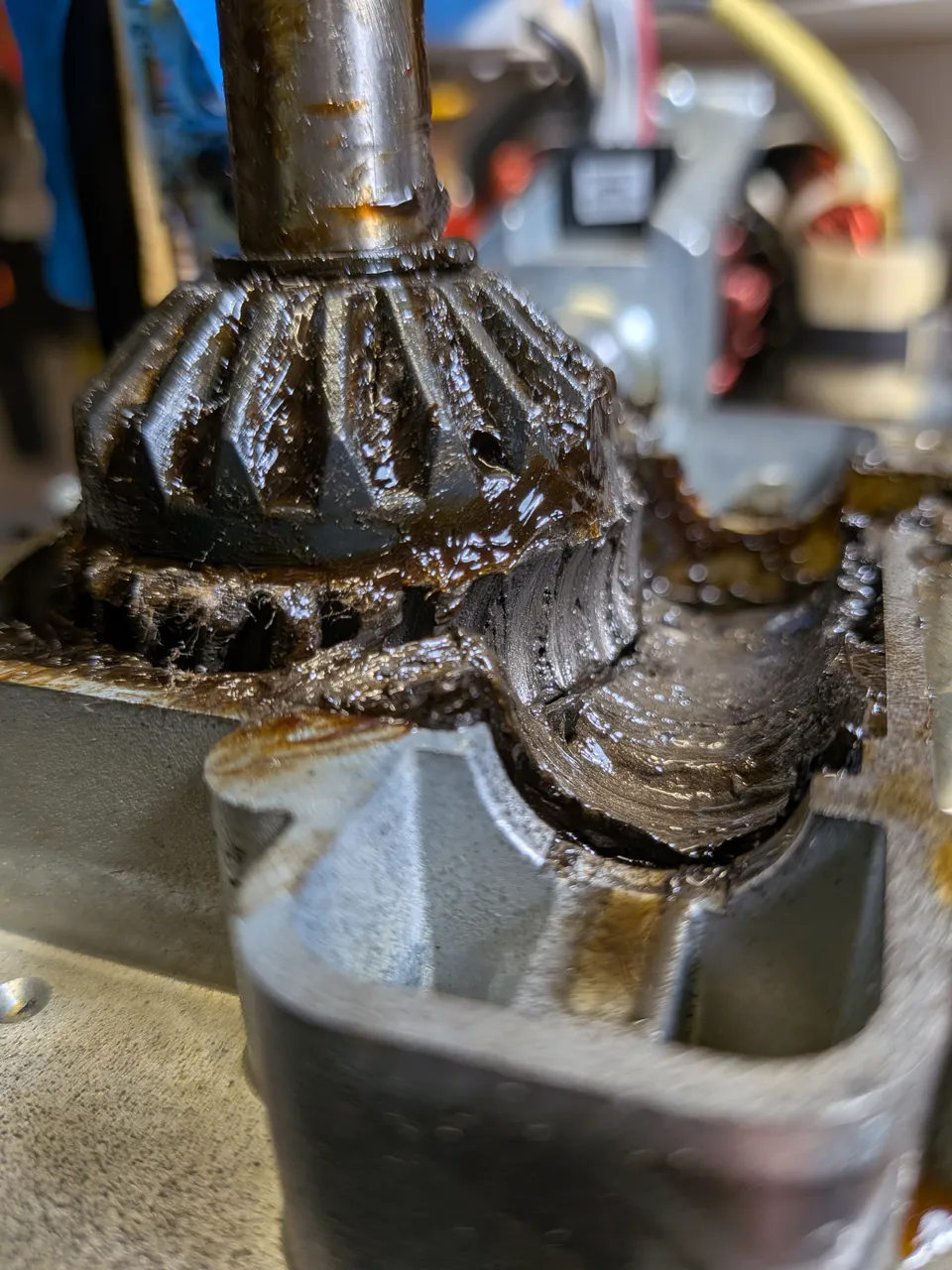
Why the beater stops while the motor keeps going
The motor sits in the back of the mixer. Its spin reaches the beater through a worm gear and a set of planetary gears in the head. The worm gear is the weak link on purpose. It is the sacrificial part, made to strip its teeth before a jammed load can burn out the motor.
Once those teeth are gone, the motor spins freely and the beater gets nothing. That is why you hear it running, sometimes with a whir or a hum, while the beater sits still or twitches.
What it usually sounds and feels like
- The mixer hums or whirs normally, but the beater does not turn, or turns slowly and stops under any load
- It stopped mid-batch, often part way through a bread or cookie dough
- There was a click, a crunch or a few seconds of grinding just before it stopped (see grinding noise)
- The beater turns freely by hand with the mixer unplugged, with none of the usual resistance
- A little oil or dark grease has shown up around the beater shaft (see leaking oil)
How to be sure it is the worm gear
- Unplug the mixer and remove the beater and bowl.
- Open the attachment hub cover at the front and look at the square drive socket inside.
- Plug the mixer in, switch it to speed 1 for a few seconds and watch the socket.
- If the socket turns and the beater shaft does not, the worm gear has stripped. If nothing turns at all and the motor is silent, it is an electrical fault instead.
The front attachment hub, where the pasta roller or grinder fits, is driven straight off the motor shaft, before the worm gear. The beater is driven after it. That gives you a one-minute test.
If the mixer is completely silent
A mixer that does nothing at all, no hum and no movement, is a different problem. The usual causes are a damaged power cord, a worn switch or a failed speed controller. A mixer that only runs at one speed, or will not switch off, is the speed controller too. If you are not sure which you have, the diagnostic sorts it out, and its price comes off the repair.
What not to do
- Do not keep switching it on to see if it has fixed itself. It has not, and the loose teeth are now grinding around inside the gearbox.
- Do not turn the speed up to try to get it moving.
- Do not force the beater round by hand while it is plugged in.
- Do not add oil through the vents. KitchenAid does not recommend adding lubricant, and it does nothing for a stripped gear.
What the repair involves
The fix is my full tune-up. I strip the head down, fit a new worm gear, replace the gasket and clean out every trace of the old grease, because the broken teeth and metal dust are now mixed through it. Then the gearbox is packed with fresh food-grade grease, reassembled and test run under load before it comes back to you, usually in 2 to 3 business days.
It is $150 on a tilt-head mixer such as an Artisan or Classic, and $175 on a bowl-lift such as a Professional 600, because the bowl-lift takes longer to open up. Both are covered for 90 days on the parts and the work.
If I open it up and find more than a worm gear, I call you with the price before doing anything else.
Why it happened, and stopping it happening again
Nearly every stripped worm gear I see comes from one of three things: kneading dough above speed 2, batches bigger than the mixer is rated for, or grease that has hardened with age and stopped protecting the gears. Older machines that have never been serviced are the most common.
After the repair, keep dough on speed 2, split dense batches in two, and let the mixer cool between heavy jobs. My one-page care guide has the rest. A re-greased mixer with a new gear will go another decade or more.
Is it worth it on an old mixer?
Almost always. A stripped gear on a 20 or 30-year-old KitchenAid is the most repairable fault there is, and the machine underneath is usually better built than a new one at the same price. The serial number decoder tells you how old yours is, and this guide walks through the decision.
The repair for this
Re-grease, gasket and worm gear replacement
$150 tilt-head
$175 bowl-lift
Confirmed before any work starts, and usually back in 2 to 3 business days. Pick up and drop off is $20 in Vaughan, Kleinburg and King City.
Related repairs
- Diagnostics$40 any mixer
- Speed controller replacement$125 tilt-head · $150 bowl-lift
- Power cord replacement$70 tilt-head · $95 bowl-lift